


Last updated: December
Real-time visualization of your stair design.
Standard Dimensions:
Safety Guidelines:
Always check local building codes for specific requirements.
Stair Calculator with Stringer Calculation | Estimates are for planning purposes only | Consult with professionals for exact measurements
Summary of Key Terms & Safety Checks
Proper stair stringer calculation requires understanding essential terminology and adhering to safety guidelines. This reference provides quick access to key terms with typical dimensions and a checklist for safe construction. The 7-11 Rule (2 × Riser Height + Tread Depth ≈ 25 inches) remains the cornerstone of comfortable stair design.
The following table defines the essential components of stair construction with typical U.S. residential code ranges:
| Term | Definition | Typical Range (USA Residential) |
|---|---|---|
| Riser | The vertical height of a single step. Uniform riser height is critical for safety and comfort. | 6.5" - 7.75"Max 7.75" per International Residential Code |
| Tread | The horizontal depth of the stepping surface. Must provide adequate foot support. | 10" - 11"Minimum 10" for most building codes |
| Nosing | The part of the tread that extends beyond the riser below. Increases usable tread depth. | 0.75" - 1.25"Often 1" for standard construction |
| Headroom | The clear vertical space measured from the stair nosing to any overhead obstruction. | Minimum 80 inches (6'8")Critical for safety and code compliance |
| Stringer | The slanted, notched board that supports the treads and risers. Usually made from 2x12 lumber. | Typically 3 stringers(2 for sides, 1 center for stairs > 36" wide) |
| Total Rise | The complete vertical height from the top finished floor to the bottom finished floor. | Varies by applicationThe starting measurement for all calculations |
| Total Run | The horizontal length the entire staircase will occupy. | Varies by applicationCalculated from tread depth × number of treads |
Before cutting or installing stair stringers, verify these essential safety and construction points:
Important Note: This information provides general guidelines for typical residential stair construction. Always consult your local building authority for specific code requirements in your area, as regulations can vary significantly. Professional installation is recommended for complex staircases or if you lack carpentry experience. Safety should always be the primary consideration in any construction project.
Understanding Stair Run
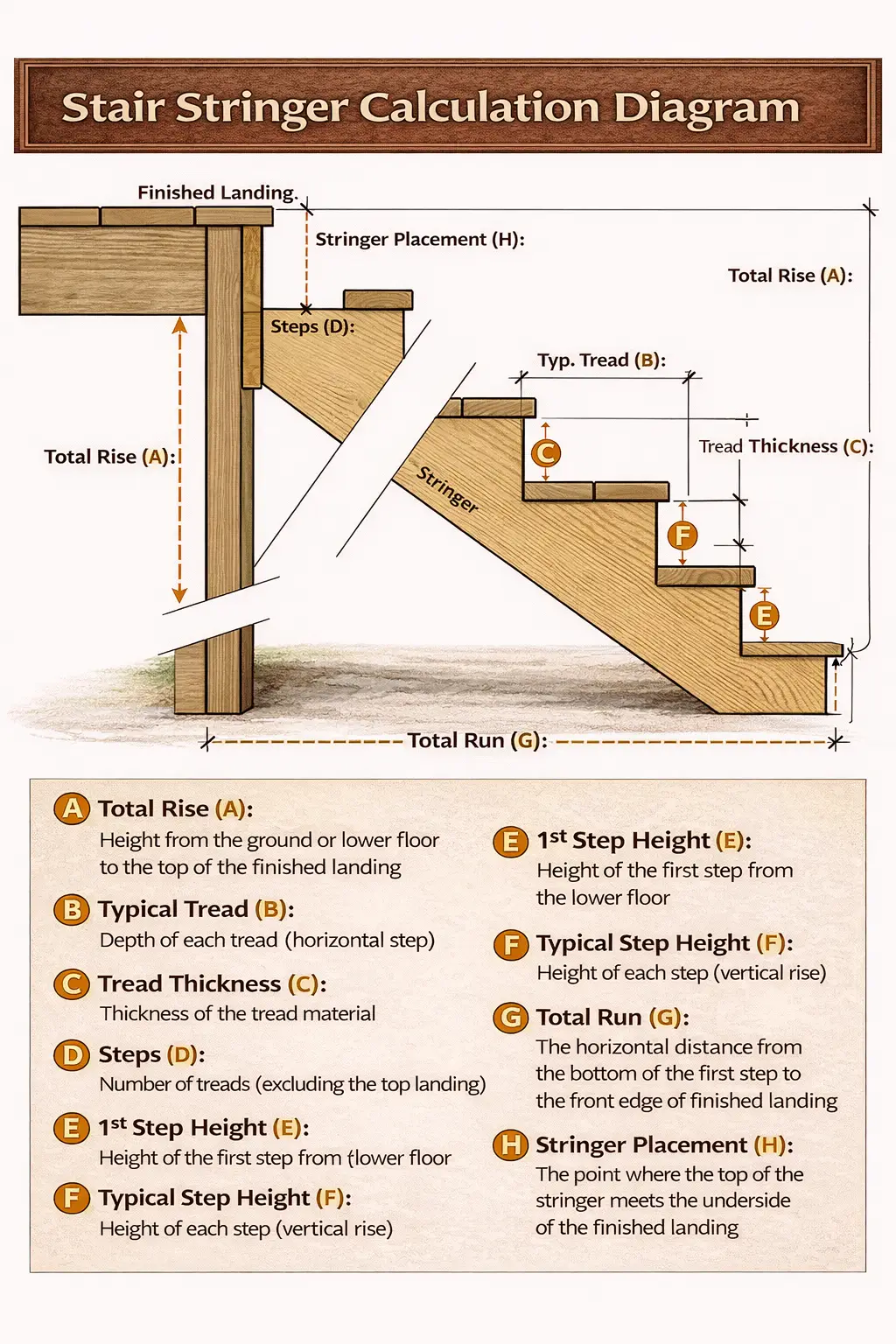
In stair construction, “run” has two related but distinct meanings:
Total Run: The total horizontal distance the staircase will project into a room, from the face of the first riser to the face of the final riser.
Tread Run (or Unit Run): The horizontal depth of a single step (the part you step on).
Calculating one depends on the other. The process follows a logical sequence.
Step 1: Gather Your Essential Measurement
You must know the Total Rise—the exact vertical height from the top finished floor to the bottom finished floor. Let’s use an example: Total Rise = 102 inches.
Step 2: Determine the Number of Risers
Divide the Total Rise by your desired riser height. Building codes typically limit residential risers to between 6″ and 7.75″, with 7″ being a very common, comfortable height.
102" ÷ 7" = 14.57
Round this result UP to the nearest whole number. You must have a whole number of risers.
Number of Risers = 15
Recalculate the exact Riser Height using this whole number.
Exact Riser Height = Total Rise ÷ Number of Risers
102" ÷ 15 = 6.8" (This is a safe, comfortable height).
Step 3: Determine the Number of Treads
A simple but critical rule: Number of Treads = Number of Risers – 1.
Why? The top floor surface acts as the final “step.”
Number of Treads = 15 – 1 = 14
Step 4: Choose Your Tread Run (Individual Step Depth)
This is a design and code decision. The ideal tread run balances comfort, safety, and space. Common standards are:
Minimum (per most codes): 10 inches.
Comfortable Standard: 10.5 to 11 inches.
The “7-11” Rule Check: For optimal comfort, the relationship (2 x Riser Height) + Tread Run should be close to 25 inches.
For our example: (2 x 6.8") + 10.5" = 24.1" (This is acceptable and close to the ideal).
Let’s choose a Tread Run of 10.5 inches.
Step 5: Calculate the Total Run
This is the final, crucial measurement for space planning.
Formula: Total Run = Number of Treads × Tread Run
Calculation: 14 × 10.5" = 147 inches
Conversion: 147 inches ÷ 12 = 12.25 feet
Result: This staircase will project 12.25 feet horizontally into the room.
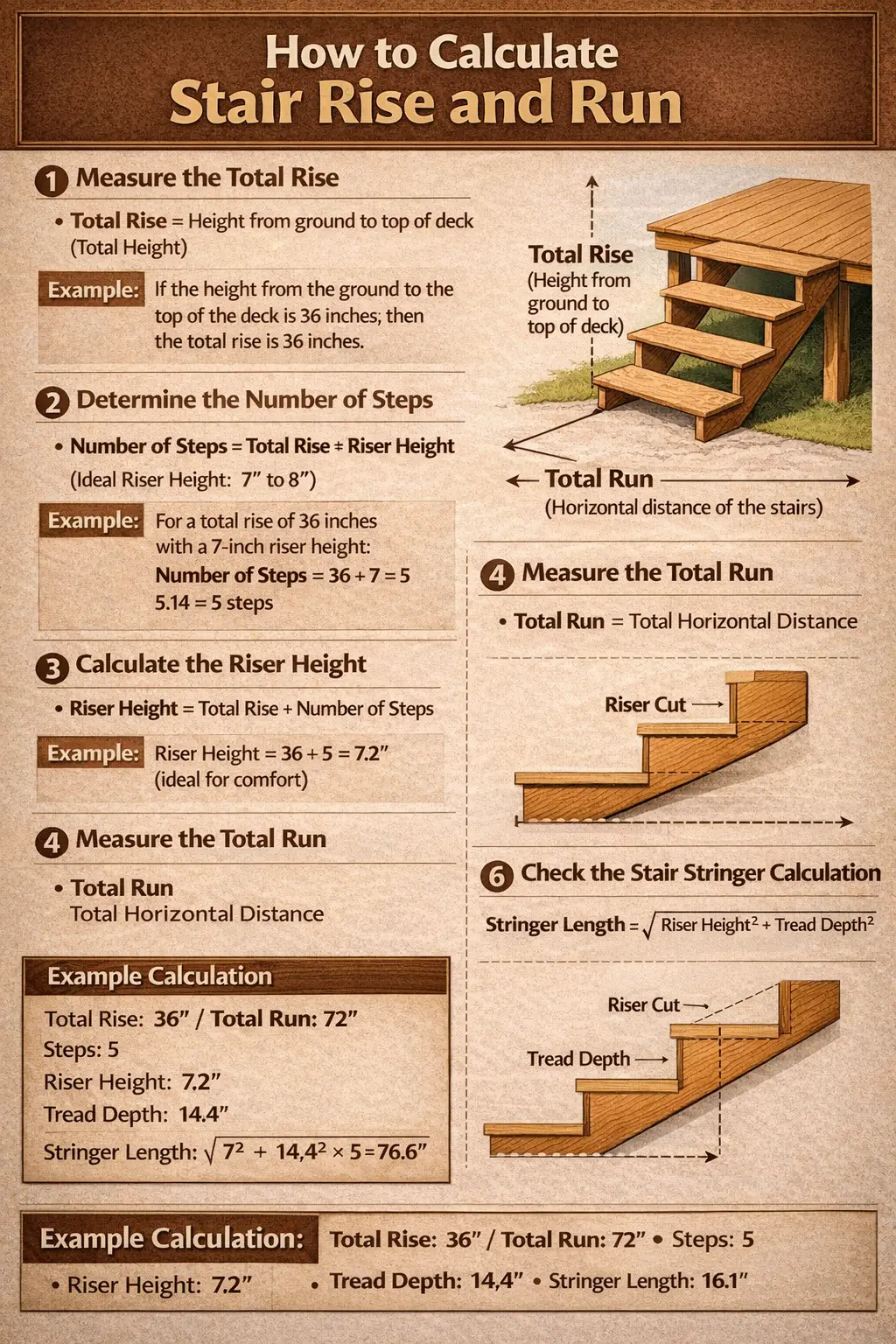
Spiral stair calculations differ fundamentally from straight stairs due to their circular geometry and tapered treads. Here’s how to approach it correctly.
Tapered Treads: Each step is wedge-shaped, wider at the outer edge
Central Pole: The staircase rotates around a central support
Variable Walking Line: The comfortable walking path is about ⅔ from the center
Building Codes: Spiral stairs have different (often more lenient) requirements
First, gather these essential measurements:
A. Total Rise
Same as straight stairs: Vertical distance from finished floor to finished floor.
Example: 120 inches (10 feet)
B. Floor Opening Diameter
The circular hole in the floor above. This determines the stair’s overall size.
*Minimum code requirement: Usually 60-68 inches diameter*
*Better comfort: 72+ inches diameter*
Example: 72 inches (6 feet)
C. Key Spiral Stair Code Requirements (International Residential Code)
Minimum tread depth at walking line (12″ from narrow end): 6.75″
Minimum tread width at 12″ from narrow end: 26″
Maximum riser height: 9.5″
Headroom: Minimum 78″ (often 80″ recommended)
Minimum floor opening: Typically 60″ diameter
Minimum clear width at walking line: 26″
Formula:
Number of Risers = Total Rise ÷ Desired Riser Height
For spiral stairs, riser height is typically greater than straight stairs:
Common range: 7.5″ to 9.25″
Recommended: 8″ to 8.75″ for comfortable use
Example using 8.5″ risers: 120" ÷ 8.5" = 14.1 risers
Rounding & Adjustment:
Round to nearest whole number: 14 risers
Recalculate exact riser height: 120" ÷ 14 = 8.57"
✅ Check: 8.57″ is within the 9.5″ maximum code limit.
Number of Treads = Number of Risers
Unlike straight stairs, spiral stairs typically have the same number of treads and risers because the bottom step starts at the floor.
*Example: 14 risers = 14 treads*

Spiral stair calculations differ fundamentally from straight stairs due to their circular geometry and tapered treads. Here’s how to approach it correctly.
Tapered Treads: Each step is wedge-shaped, wider at the outer edge
Central Pole: The staircase rotates around a central support
Variable Walking Line: The comfortable walking path is about ⅔ from the center
Building Codes: Spiral stairs have different (often more lenient) requirements
First, gather these essential measurements:
A. Total Rise
Same as straight stairs: Vertical distance from finished floor to finished floor.
Example: 120 inches (10 feet)
B. Floor Opening Diameter
The circular hole in the floor above. This determines the stair’s overall size.
*Minimum code requirement: Usually 60-68 inches diameter*
*Better comfort: 72+ inches diameter*
Example: 72 inches (6 feet)
C. Key Spiral Stair Code Requirements (International Residential Code)
Minimum tread depth at walking line (12″ from narrow end): 6.75″
Minimum tread width at 12″ from narrow end: 26″
Maximum riser height: 9.5″
Headroom: Minimum 78″ (often 80″ recommended)
Minimum floor opening: Typically 60″ diameter
Minimum clear width at walking line: 26″
Formula:
Number of Risers = Total Rise ÷ Desired Riser Height
For spiral stairs, riser height is typically greater than straight stairs:
Common range: 7.5″ to 9.25″
Recommended: 8″ to 8.75″ for comfortable use
Example using 8.5″ risers: 120" ÷ 8.5" = 14.1 risers
Rounding & Adjustment:
Round to nearest whole number: 14 risers
Recalculate exact riser height: 120" ÷ 14 = 8.57"
✅ Check: 8.57″ is within the 9.5″ maximum code limit.
Number of Treads = Number of Risers
Unlike straight stairs, spiral stairs typically have the same number of treads and risers because the bottom step starts at the floor.
*Example: 14 risers = 14 treads*
Spiral stairs typically complete 360° to 450° of total rotation.
Common Standards:
Full circle: 360° rotation (returns to same orientation)
Three-quarter circle: 270° rotation
One complete turn plus: 450° rotation (common for taller rises)
Formula:
Angle per Step = Total Rotation ÷ Number of Treads
Example for 360° rotation: 360° ÷ 14 treads = 25.7° per step
This is where spiral stairs differ dramatically. Each tread is triangular/wedge-shaped.
The “walking line” is where you actually walk, typically:
12 inches from the narrow end (code measurement point).
Approximately ⅔ of the way from center to outer edge.
This is the critical measurement for code compliance.
Example calculation for 72″ diameter stair:
Central pole diameter: 4″ (typical)
Clear radius at walking line (12″ from pole): (72" ÷ 2) - 12" = 24" radius
Circumference at walking line: 2 × π × 24" = 150.8"
Tread depth at walking line: 150.8" ÷ 14 treads = 10.77"
✅ Check: 10.77″ exceeds the 6.75″ minimum code requirement.
Outer width: Measured at widest point (outer edge)
Inner width: Measured at narrow end (near pole)
Example:
Outer width: 72″ diameter = 36″ radius
Inner width at 4″ pole radius = minimal
Effective width at walking line: Usually 24-30″ (meeting the 26″ minimum code)
For spiral stairs, “run” means the diameter of the stair’s footprint.
Formula:
Total Horizontal Footprint = Floor Opening Diameter
This is straightforward:
Your floor opening diameter is the stair’s horizontal footprint
Example: 72″ floor opening = 72″ diameter footprint = 6 feet of floor space required
Headroom Calculation (Most Critical Check)
Headroom must be checked at multiple points, especially on the inside of the curve.
Minimum headroom path: The line 12″ from the handrail (typically the walking line)
Headroom formula: Calculate the vertical clearance at each step along this line, accounting for the slope of the stair above.
Quick check: For a 360° spiral, headroom is usually adequate if:
Rise per full rotation ≤ 9.5 feet
Floor opening is sufficiently large
Comfort & Safety Factors
Step Consistency: All steps must have identical rise
Tread Taper: Ensure the narrow end is not too narrow (minimum 6″ at pole)
Handrail Height: 34-38″ vertically from the tread nosing
Baluster Spacing: Maximum 4″ sphere cannot pass through
Manufacturing vs. DIY
Spiral stairs are complex to build. Most are:
Kits: Pre-engineered with set dimensions
Custom: Professionally designed for specific spaces
Permit drawings: Usually require engineered plans
Understanding the Calculation Process
This stair calculator uses proven mathematical principles and building science to help you design safe, comfortable stairs. Here’s exactly how it works behind the scenes.
The Mathematical Foundation
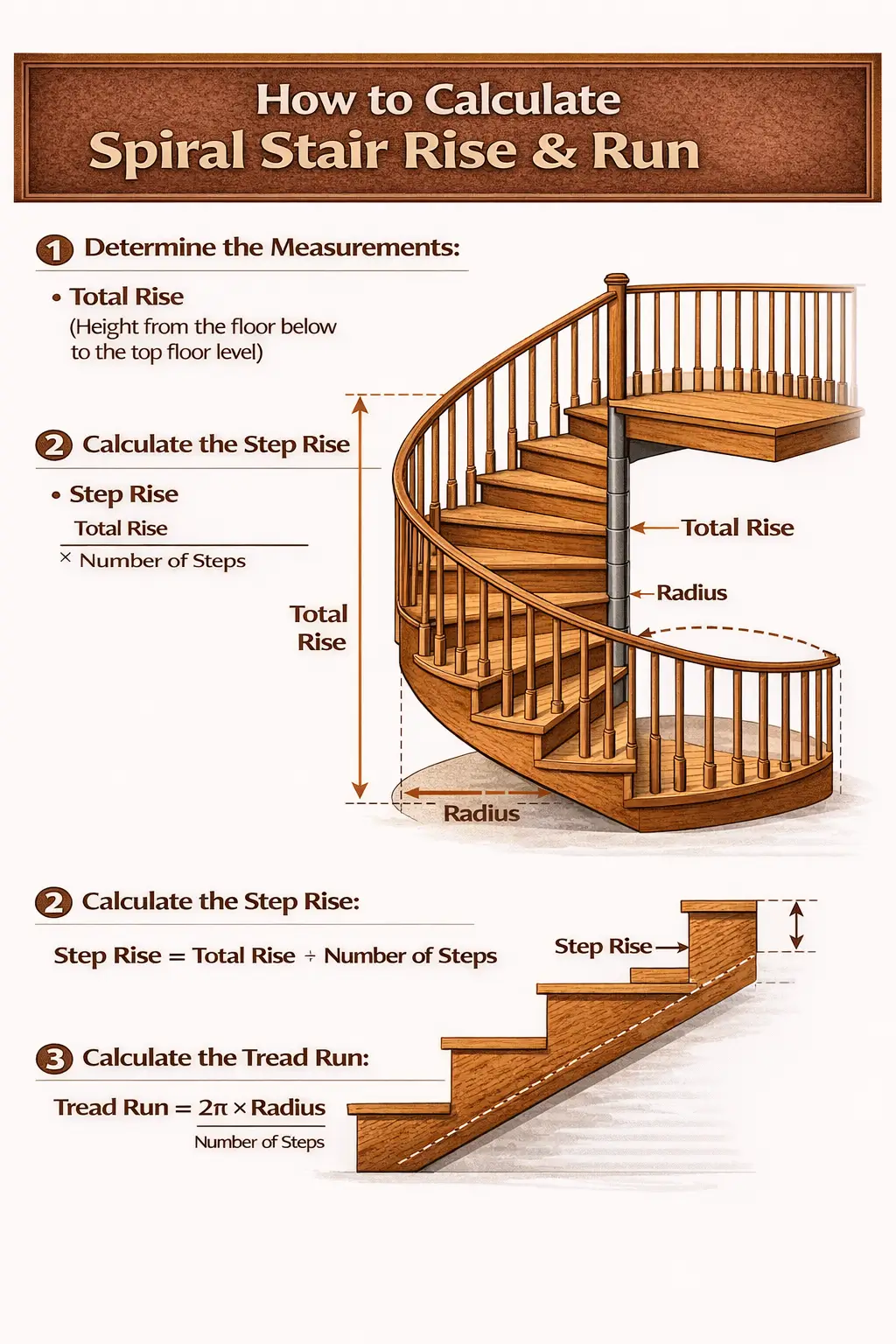
1. Right Triangle Geometry
Every straight staircase forms a right triangle:
Vertical side (Rise): Total height between floors
Horizontal side (Run): Total horizontal distance
Diagonal side (Stringer): The slanted support board
The calculator uses the Pythagorean Theorem (a² + b² = c²) to determine stringer length:
Stringer Length = √(Rise² + Run²)
2. Step Calculation Method
Here’s the step-by-step logic
Step 1: Determine Number of Risers
Why round up? This ensures no step exceeds building code maximums. If your calculation gives 14.2 risers, we use 15 to keep each step safe.
Step 2: Calculate Actual Riser Height
This gives you equal step heights – critical for safety and comfort.
Step 3: Determine Number of Treads
Number of Treads = Number of Risers – 1
The top floor acts as your final “step.”
Step 4: Calculate Tread Depth
The “7-11 Rule” (Safety & Comfort Check)
This formula ensures comfortable, safe stairs:
2 × Riser Height + Tread Depth ≈ 25 inches
What this means:
24-26 inches: Acceptable range
25 inches: Ideal comfort
Outside this range: Warning appears
This formula creates stairs that match natural human stride patterns.
Angle Calculation
The calculator determines stair steepness using this formula:
Where arctan is the inverse tangent function, converted to degrees.
Typical results:
25-30°: Gentle, comfortable stairs
30-35°: Standard residential stairs
35-40°: Steeper, space-saving
> 40°: Very steep (ladder-like)

Need help with a specific project? Explore our complete library of Calculators and Blogs.